

 English
 русский
 Español
How Can Copper Parts Maintain Accuracy and Conductivity
Take apart a power strip, a car fuse box, or a charger and you will find small copper pieces doing quiet work. A terminal may carry current, slot into a tight housing, and hold a steady connection for years. A slight bend in the wrong place or a dull patch on a contact face can change how it behaves.
Buyers therefore ask more than whether a factory can make a copper part. They want to know if the process keeps conductivity, size, stamping repeatability, and surface condition steady across thousands of pieces. Custom Copper Fabrication covers parts built to a specific structure and electrical need. Stamped Copper Parts cover repeatable shapes made with dies. Both depend on controlled materials, tooling, processing, and inspection.
Why Conductivity and Dimensions Go Together
Conductivity describes how well the material carries current. Dimensional accuracy describes whether the finished part matches the drawing and sits where it should. They are separate qualities, yet one often depends on the other.
A terminal shows the link. Its contact area must meet the electrical requirement, and its mounting features must line up with the mating part. If the shape drifts, the terminal may sit crooked and the contact becomes unstable.
Busbars and conductive sheets follow the same rule. Their dimensions decide how they fit into an electrical system, while material condition and surface quality decide how they perform once installed.
A part can pass a size check and still have a poor surface. Another can have suitable electrical properties and fail on the line because a hole sits off position. Quality plans should review electrical and mechanical requirements side by side.
Material Selection and Electrical Performance
Different copper materials vary in conductivity, strength, formability, and resistance to the environment. A manufacturer should understand the end use before recommending one.
A terminal inside a connector faces different demands from a structural copper piece in an industrial frame. A busbar may need to balance conductivity with the stiffness required for mounting and support.
Forming behavior matters as well. Some materials stamp and bend easily, while others spring back or crack if the geometry is tight. Variation in thickness, hardness, or surface condition between coils also changes how copper behaves under the die, which affects repeatability.
A capable Copper Parts Manufacturer can explain why a material suits a given part. Buyers help by sharing drawings, operating conditions, connection details, and assembly information. Material certificates and incoming inspection records give procurement teams a way to confirm that supplied copper matches the agreement.
Manufacturing Steps That Protect Accuracy
Accuracy begins with the production plan. A part may involve cutting, stamping, bending, drilling, machining, or a mix of these. Each step can shift shape or feature position.
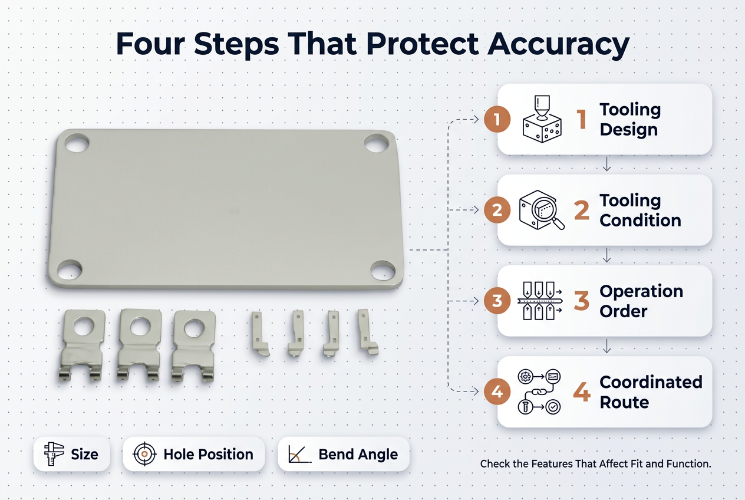
- Tooling design: The die must support the outline, holes, slots, and bends in the drawing. A mismatch between tool and part structure shows up as defects early in the run.
- Tooling condition: Worn cutting edges raise burrs and change dimensions gradually. Regular die inspection catches this before it spreads through a large batch.
- Operation order: Parts with several bends or closely spaced features can change shape as they move through stations, so each step must account for the one before it.
- Coordinated routes: Custom Copper Fabrication often adds machining, joining, or surface treatment. Planning these as one route works better than treating them as unrelated jobs.
Inspection should focus on features that affect fit and function, such as hole positions, overall size, bend angles, contact areas, and alignment of connecting features. Critical features need written acceptance limits. Less important details can be checked more lightly.
A structured route also shows where a dimension starts to move, so adjustments rest on evidence rather than repeated trial runs.
Keeping Stamping Consistent in Mass Production
Passing inspection during an initial production check does not ensure that later pieces will remain consistent. Tool wear, material differences, feeding position, and handling can all affect the finished product.
Stamped Copper Parts often carry repeated features such as mounting holes, contact tabs, narrow slots, and formed edges. Small variation becomes a real problem when parts enter automated assembly, where feeders and fixtures expect steady shapes.
Several habits keep a run stable:
- Inspect dies for wear, damage, and contamination at set intervals.
- Control how the strip enters the die, since a shifted strip shifts every feature.
- Pull samples at defined points and compare them with the approved drawing or a reference part.
- Investigate material, tooling, machine condition, and operating method whenever a deviation appears.
- Review any change in material, tooling, or forming operation before it reaches production.
Buyers feel the effect directly. Uneven parts slow installation, force manual adjustment, and cause trouble at final testing. A harness plant that has to reshape terminals by hand loses the time automation was meant to save.
Surface Treatment and Service Reliability
The surface of a copper part affects electrical contact, resistance to the environment, and the stability of a joint over time. Copper can oxidize in storage or use, which changes the condition of contact areas.
Plating is common on terminals, connectors, and other conductive parts. The coating should match the electrical, mechanical, and environmental needs of the part. It can protect a contact zone, but it cannot make up for wrong material or poor forming.
Surface preparation is essential. Oil, dust, and leftover residue can cause uneven coverage or poor adhesion. Some components require coating across the entire surface, while others need treatment only in areas that come into contact. This requires careful masking and process control to protect features that must remain unchanged.
Inspection should check appearance and coverage, plus any requirement tied to the application. Buyers should state the finish they expect, the areas to treat, and the operating conditions. A well-formed part with the wrong finish can still fail after assembly, so finishing belongs in the overall quality plan.
Inspecting Finished Copper Parts
A visual check catches obvious flaws but cannot confirm every electrical or size requirement. Inspection should reflect what the part actually does.
Dimensional checks compare critical features with the approved drawing: outer profile, hole positions, thickness, bend geometry, and contact dimensions. The method must suit the feature, since a caliper that works for a width may not suit a bend angle.
Electrical checks assess whether the material or finished part meets the agreed requirement. For assembled contacts, testing may need to consider the connection structure, not just the copper.
Surface inspection looks for scratches, burrs, discoloration, contamination, and uneven plating. Judge each by its effect on function. A cosmetic mark on a hidden edge may be acceptable, while the same mark on a contact face may not.
A practical plan includes these stages:
- Incoming material: check identification, condition, and documents.
- Tooling and process: confirm dies and equipment suit the part.
- In-process checks: watch critical dimensions and forming conditions.
- Finished parts: review dimensions, surface, and electrical requirements.
- Batch records: keep results traceable for later review.
Records help both sides find recurring defects and compare batches using evidence. Agree on the plan before mass production, so nobody argues about acceptable quality after parts are made.
Evaluating a Copper Parts Manufacturer
Quotations and press lists do not show how a supplier manages the full process. Look at the path from drawing review to final inspection.
A Copper Parts Manufacturer should study the intended use and raise concerns before cutting steel for dies. Tight bends, narrow features, contact requirements, material limits, and surface needs all deserve discussion at that point. Buyers should supply clear drawings and explain how the part is installed, including dimensions of mating components.
For OEM work, agree on how revisions are handled. A new drawing, material swap, or tooling change can alter the finished part, so review and approval should be documented.
| Area | Questions for the Supplier |
|---|---|
| Material | How is copper identified and inspected? |
| Capability | Can the plant handle the stamping, bending, and machining needed? |
| Dimensions | How are critical sizes checked during production? |
| Surface | Can required plating or finishing be managed? |
| Electrical | Which methods verify conductive performance? |
| Consistency | How are tooling condition and changes monitored? |
| Records | Can results and material data be traced? |
| OEM support | How are drawing reviews and revisions handled? |
Clear answers tied to your part say more than broad claims. Approve samples before release, checking dimensions, surface, and assembly fit, and confirm any changes before the production version starts.
Applications Across Industries
Each industry asks different things of a copper part.
- Electronics: Small contacts and terminals link circuits and cables inside compact housings. Size and surface condition affect contact reliability.
- New energy equipment: Busbars and conductive sheets distribute power. Material, forming quality, and contact design all need attention.
- Automotive harnesses: Terminals connect circuits, and a poorly fitting part complicates assembly or weakens a joint. Consistent stamping and controlled finishing support stable installation.
- Communication equipment: Compact conductive parts must fit limited space, so small shifts in shape or position affect alignment.
- Industrial control: Terminals, connectors, and power assemblies face repeated connections and demanding conditions. Buyers should describe the working environment so material and finish can be chosen to match.
Across these fields, Custom Copper Fabrication means more than cutting a requested shape. It matches material, process, surface, and inspection to the final use.
A dependable sourcing process starts with clear technical communication. Drawings should mark critical dimensions and contact areas, purchase documents should state material and finish expectations, and sample approval should confirm fit in the real assembly. A manufacturing partner that coordinates copper processing, stamping, precision machining, and plating within one controlled route helps terminals, busbars, and other conductive parts move smoothly from prototype to regular OEM production.

 Yongkang Ruizan Industry and Trade Co., Ltd.
A company specializing in metal stamping and mold design and manufacturing.


- Phone: +86-18072455799
- Email: [email protected]
- Address: No. 23, Qilong Road, Natural Village, Zhiying Town, Yongkang City, Jinhua City, Zhejiang Province, China
Copyright © Yongkang Ruizan Industry and Trade Co., Ltd. All Rights Reserved.

Custom Stamping Sheet Metal Hardware Machining Factory