

 English
 русский
 Español
How Do Custom Metal Stamping Parts Support Mass Production
A purchasing team approves a bracket sample in spring and places a large recurring order for autumn. By the third batch, hole positions have drifted and edges show burrs that the sample never had. The drawing did not change. Tooling wear, material variation, or process drift did. Custom Metal Stamping Parts, and Stainless Steel Stamping Parts in particular, suit high-volume work because the forming sequence repeats once dies and parameters have been validated. That repeatability holds only when tooling, material, and inspection are planned together.
Looking at process choice, die design, material behavior, cost, and quality control helps manufacturers keep batches consistent and supply steady over many months.
Why Does Stamping Suit High-Volume Production?
High-volume manufacturing depends on repeatability. A part must meet its drawing in the run and in the twentieth. Stamping uses dies to shape sheet metal through controlled mechanical operations, so the same sequence can run across large batches instead of machining each piece one at a time.
This approach suits parts with repeated geometry, such as brackets, housings, clips, mounting plates, and structural fittings. Dedicated dies hold the intended shape, automated feeding carries material through successive operations, and machine-driven forming limits manual handling. Standardized processes also make recurring orders easier to schedule, which matters when a buyer depends on regular deliveries.
Press speed alone does not decide efficiency. Material feeding, die alignment, setup routines, tool condition, and downstream handling all shape the real production flow. A coordinated process reduces interruptions and unnecessary adjustments, while a fast press with poor setup discipline produces scrap quickly.
Which Stamping Process Fits the Part?
Component design and order pattern guide the choice. The decision affects tooling investment, production flow, and dimensional control, so it deserves attention at the engineering stage.
Progressive Die Stamping
Sheet material advances through a series of stations, and each station performs an operation such as punching, bending, or shaping. The part gains its geometry step by step. This approach combines several operations in one sequence, reduces repeated manual positioning, supports automated feeding, and keeps successive operations consistently related to each other. It often suits electrical components, automotive fittings, and appliance brackets.
Single-Stage Stamping
Simpler shapes that need only a few operations may be produced with an individual die. Before choosing this route, review the geometry, tolerances, order pattern, and tooling investment together. A simple part ordered in modest quantities may not justify a multi-station tool.
| Consideration | Progressive Die | Single-Stage |
|---|---|---|
| Part geometry | Multiple forming features | Simpler features |
| Production flow | Sequential operations | Individual operations |
| Material handling | Continuous feeding possible | Depends on setup |
| Tooling | Multiple stations | One operation die |
| Typical use | Repeated complex parts | Simpler stamped parts |
The process should match the actual part and expected demand, not the speed of the machine.
How Does Tooling Design Affect Stability?
A die influences geometry, accuracy, and repeatability for every part it produces. For high-volume Stainless Steel Stamping Parts, the design must account for material behavior, part geometry, forming sequence, and production conditions.
Matching the Geometry
Engineers start with the drawing and identify critical dimensions, hole positions, bends, thickness, and zones of heavy deformation. They then consider punch and die clearances, forming sequence and material movement, bend radii and compensation, strip layout and material use, and how parts and scrap leave the die. Problems left unresolved at this stage tend to reappear later as inconsistent output.
Maintenance
Repeated contact and loading gradually wear cutting edges, forming surfaces, and alignment. Unnoticed wear lets parts drift from specification, as in the bracket example above. A routine should include inspecting critical surfaces, checking punch and die condition, reviewing alignment and clearance, cleaning debris from working areas, and recording maintenance together with production observations. Records make it easier to link a change in part quality to a change in tool condition.
Which Stainless Steel Grade Should Be Used?
Grades differ in mechanical characteristics and corrosion resistance, and their forming behavior influences both tooling and finished quality.
| Material | General Characteristics | Possible Applications |
|---|---|---|
| 304 stainless steel | General corrosion resistance and formability | Brackets, housings, appliance parts |
| 316 stainless steel | Better resistance to chloride-related corrosion | Marine fittings, chemical equipment parts |
Selection should reflect the operating environment, mechanical needs, surface condition, and manufacturing requirements. A kitchen appliance bracket and a coastal fitting face very different conditions, and the grade should reflect that.
Thickness and Consistency
Thickness affects forming force, bending behavior, and final dimensions, and incoming variation changes how parts behave in the press. Before production starts, verify grade and certification, thickness and tolerance, surface condition, and suitability for forming. Stable material specifications reduce adjustments between batches.
Springback and Work Hardening
Stainless steel hardens as it deforms and partly recovers after bending, which alters the final shape. Die compensation, changes to the forming sequence, and controlled production conditions address this, so parts keep their geometry across repeated runs.
How Is Cost Controlled?
Cost involves more than one forming operation. Tooling, material use, setup, inspection, secondary processing, and interruptions all contribute, so a well-planned Custom Metal Stamping Parts project considers them before production begins.
Tooling Investment
Dedicated tooling needs upfront engineering and die development. That investment can be spread across successive orders when demand and design stay fairly stable. Expected order frequency, tooling life, and the chance of design revisions all belong in the decision.
Material Layout
Strip layout affects how many usable parts each sheet or coil yields. Part spacing, feed direction, scrap removal, and orientation can reduce waste while keeping enough material support during forming. Small layout gains add up across large volumes.
Secondary Operations
Deburring, tapping, machining, finishing, cleaning, or assembly may follow forming. Planning these steps early avoids extra handling between operations and helps the whole flow run smoothly.
How Is Batch Consistency Maintained?
A part that passes at sampling must keep passing in recurring production. Consistency therefore ties together material inspection, tooling condition, process monitoring, and final verification.
Incoming Material
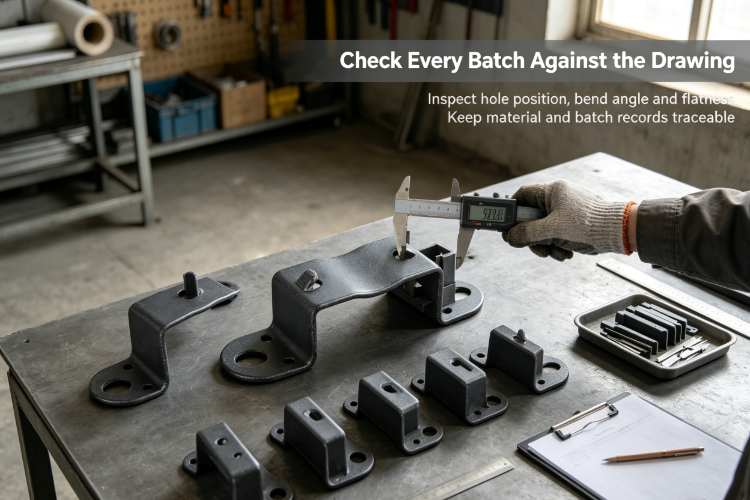
confirm grade, thickness, surface condition, and documents, and keep material clearly identified so specifications are not mixed on the shop floor.
First Piece
check initial parts against the approved drawing and customer requirements to confirm that tooling and process produce the intended geometry. Later production then follows the established criteria.
In Process
inspect features that affect fit and function, such as overall dimensions, hole diameter and position, bend angles, flatness and profile, and surface defects. Regular checks catch change before it affects a whole batch.
Traceability
linking material records, batches, inspection results, and delivery documents helps purchasing and quality teams investigate discrepancies and coordinate corrective action.
| Stage | Inspection Focus | Benefit |
|---|---|---|
| Incoming material | Grade, thickness, surface | Consistent raw material |
| Initial production | Geometry and critical dimensions | Process validation |
| In-process | Dimensional change, forming defects | Early detection |
| Final inspection | Drawing requirements, appearance | Shipment verification |
| Batch records | Material and production identity | Traceability |
What Should Be Evaluated in a Manufacturer?
Producing a part once is different from producing it consistently across many orders. A suitable partner understands how design, tooling, material behavior, equipment, and inspection relate to one another.
Engineering Support
The manufacturer should review drawings, flag likely production difficulties, and discuss practical tooling solutions before committing to a plan. Early feedback on a tight bend or a hole too close to an edge saves time later.
Equipment
Press capacity, working area, feeding arrangements, and tooling compatibility should fit the part. Automation helps with feeding and handling, provided the whole line is coordinated and not just one machine.
Quality Management
Look for defined procedures covering material verification, tooling maintenance, dimensional inspection, and acceptance. Clear communication matters equally, including how specifications are confirmed, how production changes are handled, and how inspection findings are reported to the customer.
How Should a Project Be Prepared?
Preparation reduces uncertainty before a quotation and shortens the path from sample to production.
Drawings
share two-dimensional drawings or three-dimensional models with dimensions, tolerances, and critical features marked.
Material
state the stainless grade, thickness, surface requirements, and any documentation needed.
Production
describe the initial quantity, expected repeat orders, and delivery schedule.
Quality
identify critical dimensions, functional requirements, inspection criteria, and packaging needs.
Samples
evaluate prototypes or initial samples for geometry, material behavior, and function before releasing regular production.
How Can Buyers Start the Conversation?
Stable high-volume supply begins with a clear picture of the component and its manufacturing needs. Buyers with brackets, housings, mounting parts, or other custom-formed components are welcome to contact our team with drawings, material specifications, and production requirements to discuss tooling, feasibility, and batch quality control for their Custom Metal Stamping Parts or Stainless Steel Stamping Parts project.

 Yongkang Ruizan Industry and Trade Co., Ltd.
A company specializing in metal stamping and mold design and manufacturing.


- Phone: +86-18072455799
- Email: [email protected]
- Address: No. 23, Qilong Road, Natural Village, Zhiying Town, Yongkang City, Jinhua City, Zhejiang Province, China
Copyright © Yongkang Ruizan Industry and Trade Co., Ltd. All Rights Reserved.

Custom Stamping Sheet Metal Hardware Machining Factory