

 English
 русский
 Español
How to Select 304, 316, and 430 Stainless Steel Stamping Parts
A small bracket sits inside a dry control cabinet for years without a mark. An identical bracket bolted near a washdown line shows rust-colored streaks within a season. The shape is the same. The environment is not, and the grade decides which one survives.
For Stainless Steel Stamping Parts, 304, 316, and 430 are common choices. They differ in corrosion resistance, forming behavior, magnetic response, and cost. Here is how to match each grade to the environment, the geometry, and the budget, so the material fits the job instead of just the catalog.
How the Three Grades Differ
Each grade contains a different mix of elements. That mix shapes how it reacts to moisture, chemicals, and forming. Finished parts can look alike, yet their behavior in service is not the same.
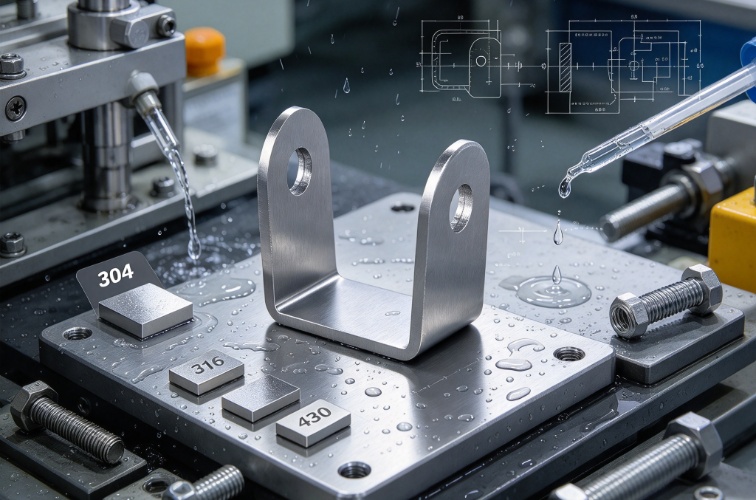
304 balances corrosion resistance and formability. It suits general equipment, housings, and brackets in moderate conditions, both indoors and in sheltered outdoor spots.
316 adds molybdenum, which improves resistance to many chloride-related conditions such as salty air, salt deposits, or some cleaning agents.
430 is a chromium-based grade with magnetic properties. It generally resists corrosion less well than 304 or 316 in demanding settings, but it can fit milder indoor uses.
| Grade | General Character | Typical Uses |
|---|---|---|
| 304 | Balanced resistance and formability | Housings, brackets, formed components |
| 316 | Better resistance in chloride conditions | Coastal equipment, processing areas, frequent cleaning |
| 430 | Magnetic, suited to milder settings | Indoor covers, appliance parts, trim |
These descriptions are starting points, not a ranking. Exposure, shape, finish, and service life decide the final call.
Matching Grade to Environment
Corrosion Exposure
Moisture, humidity, cleaning products, and salt all test a surface. Even a small stamped part can become a maintenance problem if the grade does not fit its surroundings. A clip behind a panel may never see water, while a support plate under a sink sees it daily.
304 handles many everyday conditions. Trapped dirt, poor drainage, surface contamination, or unsuitable chemicals can still cause trouble, so it is not a guarantee.
316 earns its place near the coast, or where salt deposits and chemical cleaning are routine. Its molybdenum content helps against chloride attack, but it is not immune to corrosion, and the specific environment still needs review.
430 works in dry indoor use. It may struggle with persistent wetness, salt, or aggressive cleaners, where a part can stain or pit sooner than expected.
Design matters as much as grade. Narrow gaps hold water and residue, while smooth, reachable surfaces clean easily. Review the grade and the geometry together.
Where Each Grade Fits
304: A bracket that wraps a housing and keeps mounting holes aligned is a typical case. So is a cover with folded edges for stiffness. Its forming behavior lets designers work with bends, drawn shapes, and formed ribs, although the result still depends on thickness, grain direction, tooling, and method.
Surface condition counts too. Scratches and embedded particles from handling can affect appearance and corrosion behavior, so protect the sheet during production and storage. If the part faces strong chlorides or demanding chemicals, evaluate a more resistant grade. If it sits in a dry enclosure with little forming, another grade may balance cost better.
316: Fasteners, support plates, panels, and covers near cleaning fluids or standing water may justify it. Choose by actual exposure, not by industry label. Concentration, temperature, contact time, and rinsing practice all change the picture, and the same cleaner can behave differently from site to site.
It usually costs more. That is worthwhile when corrosion affects product life, cleaning routines, or maintenance planning, and wasteful in a mild setting. Product design and upkeep still matter, since material choice cannot replace them.
430: Suited to appliance parts, covers, trim, and indoor equipment where appearance and magnetic response matter. It is magnetic, while 304 and 316 are generally non-magnetic in the annealed condition. Forming can change magnetic behavior in some stainless grades, so do not use a magnet as the only identification test.
The magnetic property helps when a part must hold a magnetic attachment. In other products it may have no practical effect. Choosing 430 purely for price can backfire if the part later meets moisture or salt, because replacement and maintenance may cancel the early saving.
Formability and Bend Radius
Formability describes how well sheet takes a shape without cracking, tearing, or distorting. Stamping combines cutting, bending, drawing, and forming small features, so the grade must tolerate every planned operation.
304 forms well across many brackets, shells, and housings when geometry and process suit it. 316 forms many common shapes too, but do not assume it behaves exactly like 304 under every condition. 430 handles some bends and features, yet complex or deep shapes need extra review of depth, grain direction, and forming sequence.
| Design Feature | What to Review |
|---|---|
| Simple bends | Direction, radius, surface condition |
| Deep formed shapes | Material response, risk of tearing |
| Narrow flanges | Available material, tool access |
| Holes near bends | Distortion during forming |
| Repeated features | Process consistency, dimensional control |
Bend radius controls strain at the corner. A radius that suits one grade may crack or mark another. The right choice depends on thickness, bend direction, tooling, and the finished shape.
Ask whether a sharp corner is truly needed. A slightly larger radius often eases forming and leaves fit and appearance untouched. Raise this with the supplier before tooling starts, because changes after tooling cost more. Do not copy hole positions and bend settings from an older part made in a different grade without checking them.
Cost, Finish, and Supplier Talks
Cost Against Service Life
A cheaper sheet is not a saving if the part needs frequent cleaning or replacement. Selecting 316 for a part in a dry cabinet adds cost with no benefit. Choosing 430 for a salty washdown area invites early failure.
Weigh the whole service picture: exposure, cleaning, forming, inspection, and replacement. Material availability and production needs also affect the project plan, so discuss them early.
Surface Finish
Grade alone does not set the final surface. Tool condition, handling, forming, cleaning, and finishing all play a part. Scratches and embedded contamination matter where appearance or cleanliness counts, such as food-related areas or visible panels.
State the requirement clearly. A visible panel may need consistent grain direction, while a hidden bracket mainly needs fit and function. Protective film, careful packaging, and clean storage limit damage before assembly or installation.
What to Share with the Supplier
A supplier can judge whether a grade suits the shape, environment, and process, but only with clear information.
- Corrosion exposure and cleaning methods
- Bend locations, hole placement, and forming complexity
- Required finish and dimensional needs
- Assembly relationships, with drawings or models if available
- How material identity will be confirmed and parts inspected
Put agreed material requirements on the drawing and order documents. That prevents misunderstandings between purchasing, production, and inspection.
Matching Material to Geometry
Look at the finished part as a whole. A component with several tight bends and formed features asks more of the material than a flat cover. A part exposed to salt or repeated chemical cleaning needs more corrosion resistance than one in a controlled indoor space.
Start from function, exposure, and shape, then compare 304, 316, and 430 against them. Small adjustments to a bend, hole position, or edge shape can ease forming while keeping function intact, and they are easiest before tooling and inspection plans are fixed.
Linking material properties with geometry, working conditions, and manufacturing method helps Stainless Steel Stamping Parts meet their service demands with fewer changes during development.

 Yongkang Ruizan Industry and Trade Co., Ltd.
A company specializing in metal stamping and mold design and manufacturing.


- Phone: +86-18072455799
- Email: [email protected]
- Address: No. 23, Qilong Road, Natural Village, Zhiying Town, Yongkang City, Jinhua City, Zhejiang Province, China
Copyright © Yongkang Ruizan Industry and Trade Co., Ltd. All Rights Reserved.

Custom Stamping Sheet Metal Hardware Machining Factory